


The traditional managed IT services model was built on a straightforward premise: monitor systems, respond when something breaks, and keep the environment running within acceptable parameters. It was, at its core, a reactive discipline dressed in proactive language. Monitoring detected failures. Support resolved them. The cycle repeated.
That model is being fundamentally reshaped by the same forces transforming analytics across every other business domain. Predictive analytics, machine learning-driven anomaly detection, and AI-powered infrastructure management are moving IT operations from a reactive discipline into a genuinely predictive one. The shift means that the most sophisticated managed IT programs are no longer primarily concerned with how quickly they respond to failures. They are concerned with identifying the precursor signals that indicate a failure is coming and intervening before it happens.

For Boca Raton businesses operating in data-intensive financial services, healthcare, and professional services environments where downtime carries real costs to client relationships and regulatory standing, this transition from reactive to predictive IT management represents one of the most practically significant technology shifts of the current decade.
Understanding how it works and why it matters for businesses in South Florida’s most active business corridor is the starting point for making informed decisions about the IT management model that best serves a business’s operational needs.
The Data Foundation of Predictive IT Management
Predictive IT management begins with data. Modern IT infrastructure generates telemetry continuously at a volume and variety that the traditional monitoring tools designed to alert on binary pass/fail states were never equipped to process analytically. Server performance metrics that capture CPU, memory, disk, and network utilization patterns over time. Application performance data that reflects response latency, error rates, and throughput at a granular, time-series level.
Network traffic data that captures communication patterns between systems and with external endpoints. Security event data that overlaps with the performance picture to provide a unified view of infrastructure health. And endpoint telemetry that reflects the behavior of every device in the organizational environment.
The analytical challenge is not collecting this data. Modern infrastructure monitoring tools generate it by default. The challenge is processing it in ways that produce meaningful predictive intelligence rather than a volume of alerts that overwhelms the human analysts responsible for acting on them.
Machine learning models applied to infrastructure telemetry address this challenge in several ways. Time-series forecasting models trained on historical performance data identify the trajectory of degradation patterns before they reach failure thresholds. Anomaly detection models that have established baseline performance profiles for each infrastructure component flag deviations that indicate emerging problems without requiring a threshold breach to trigger an alert. And correlation models that analyze patterns across multiple data streams simultaneously identify the combinations of signals that have historically preceded failure events, even when no individual signal alone would cross an alert threshold.
The output is an intelligence layer on top of the raw infrastructure data that transforms monitoring from a threshold-alerting function into a genuine early warning system.
What Predictive Models Identify That Traditional Monitoring Misses
The practical difference between threshold-based monitoring and predictive analytics in IT management is most clearly visible in the categories of failure that each approach addresses effectively.
Traditional threshold monitoring catches acute failures reliably. A server that exceeds a defined CPU utilization percentage triggers an alert. A disk that reaches a defined fill level triggers a warning. A service that stops responding generates an immediate notification. These are the failure events that monitoring was designed to catch, and for this category of event, threshold monitoring performs its function adequately.
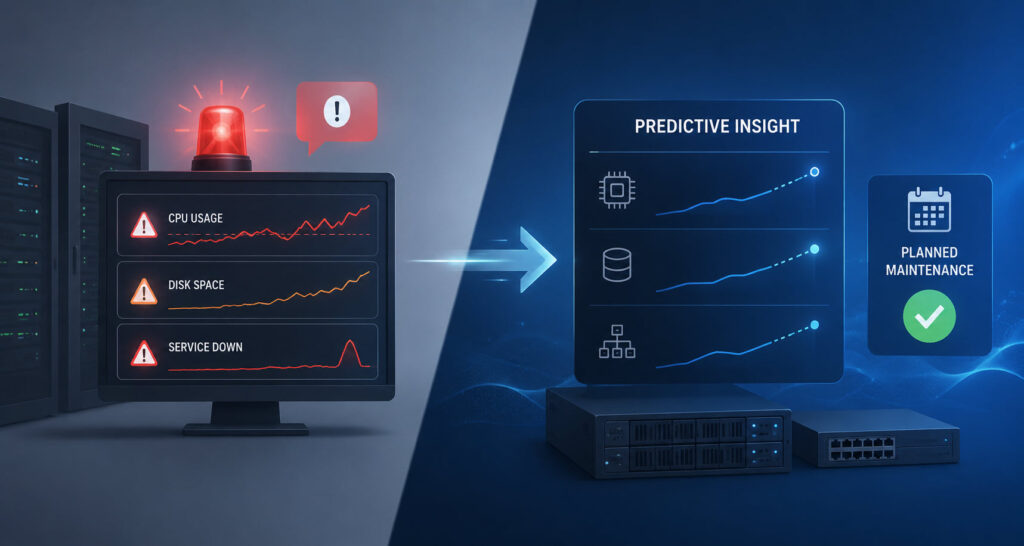
The failures that threshold monitoring consistently misses are the gradual, multi-factor degradation events that are far more common in production infrastructure and far more expensive to address when they finally produce a visible failure. A storage array whose read latency has been increasing incrementally over six weeks does not cross a single alert threshold until it produces a performance impact that users notice, even though the degradation pattern was visible in the data weeks before the impact materialized.
A network switch whose error rate has been drifting upward over time does not trigger an alert until the error rate crosses an absolute threshold, even though the trend line was pointing toward a failure event that could have been addressed during a planned maintenance window rather than as an emergency outage.
Predictive analytics applied to these gradually degrading infrastructure components identifies the trend lines and the correlation patterns that indicate a failure trajectory before any individual threshold is crossed. A storage array whose latency trend is accelerating at a rate that projects to a performance impact in four weeks becomes a planned maintenance item rather than an emergency response. A network device whose error rate trend correlates with historical failure precursors in the training data becomes a proactive replacement rather than a reactive disruption.
The operational and economic difference between these two outcomes is substantial for businesses in Boca Raton where IT reliability directly affects client service quality and regulatory compliance posture.
The Business Intelligence Layer That Predictive IT Management Produces
The data generated by a predictive IT management program is not only useful for avoiding infrastructure failures. It produces a business intelligence layer that informs better decisions about infrastructure investment, capacity planning, and IT budget allocation.
Infrastructure utilization analytics that reveal how capacity is actually being consumed across the environment identify over-provisioned resources that represent unnecessary cost and under-provisioned resources that represent a reliability risk. For Boca Raton financial services firms managing IT budgets against revenue and margin targets, the ability to right-size infrastructure based on actual utilization data rather than conservative estimates is a direct cost management capability.
Application performance trend data that shows how the systems supporting core business operations are performing over time provides the evidence base for proactive capacity expansion before growth pressure creates performance problems. A wealth management firm whose client data platform is showing a utilization trajectory that projects to a capacity constraint in six months can plan and execute an expansion during a low-impact window rather than responding to a performance crisis that arrives without warning.
Failure pattern data that accumulates across the managed environment over time reveals the infrastructure components, vendors, and configuration categories with the highest failure rates and the greatest impact when they fail. This data informs vendor selection decisions, configuration standards, and maintenance priority frameworks that reduce failure rates in future infrastructure generations based on empirically observed patterns rather than vendor claims or industry averages.
Why Boca Raton’s Regulated Business Environment Makes This Capability Particularly Valuable
The business case for predictive IT management is compelling across industries, but it is particularly strong in the regulatory environments that define much of Boca Raton’s commercial landscape.
For financial advisory and wealth management firms regulated by SEC and FINRA, IT reliability is not only an operational concern. It is a compliance concern. System availability that affects the ability to execute client transactions, access client account data, or meet regulatory reporting deadlines creates compliance exposure alongside operational disruption. Predictive IT management that reduces unplanned downtime is simultaneously reducing the business disruption risk and the compliance risk that IT failures create in this regulatory context.
For healthcare organizations subject to HIPAA, system availability and data integrity are directly connected to patient care quality and regulatory standing. Electronic health record system downtime that forces clinical staff to manual processes creates care delivery risk and documentation gaps that regulatory auditors take seriously. Predictive management of the infrastructure supporting these systems is a patient safety investment as much as an IT operations investment.
For real estate and professional services firms where client relationship continuity is the primary asset, the reputational cost of service disruptions that affect client-facing operations creates a business case for IT reliability that extends beyond the direct cost of the outage itself. A transaction that fails to close on schedule because of an IT disruption carries costs measured in client relationships and referral pipelines, not just in IT labor hours.
How AI Is Accelerating the Predictive Capability in Modern Managed IT Programs
Machine learning’s role in predictive IT management has expanded significantly as the models underlying these systems have access to larger training data sets, more sophisticated feature engineering, and more compute resources for inference than the earlier generations of analytics-driven monitoring tools could access.
Generative AI applications are beginning to augment predictive monitoring with natural language explanation of predicted failure risks that allows non-technical stakeholders to understand infrastructure health status without requiring deep technical interpretation. A business owner in Boca Raton reviewing a monthly IT health report that explains in plain language which systems are trending toward issues, why the trend has been identified, and what the recommended response is has meaningfully better visibility into their technology environment than one receiving a list of technical metrics with threshold indicators.
Reinforcement learning models that improve their predictive accuracy over time based on the outcomes of the interventions they recommend are beginning to appear in the most sophisticated managed IT platforms, creating systems whose predictive capability compounds as their operational history grows. An IT management program that has been operating in a specific environment for two years has significantly better failure prediction accuracy for that environment than one that has been operating for two months, because the longer-running program has more environment-specific training data to draw from.
How Mindcore Technologies Delivers Predictive IT Management in Boca Raton
Mindcore Technologies brings more than 30 years of IT operations and analytics experience to Boca Raton businesses that need IT management capabilities that match the operational and regulatory demands of South Florida’s most active business sectors. Under the leadership of Matt Rosenthal, CEO of Mindcore Technologies, the company delivers managed IT services in Boca Raton that integrate predictive analytics, AI-driven monitoring, and the human expertise required to translate data-driven infrastructure intelligence into operational outcomes.
Mindcore’s managed IT approach is built on continuous telemetry collection, machine learning-driven anomaly detection, and the proactive intervention model that predictive monitoring enables. Their clients in Boca Raton’s financial services, healthcare, and professional services sectors benefit from IT management that addresses the specific operational reliability and regulatory compliance requirements of their industries while building the infrastructure business intelligence that supports better technology investment decisions over time.
Conclusion
The transition from reactive to predictive IT management is not a technology trend that Boca Raton businesses need to anticipate. It is an operational reality that the most sophisticated managed IT programs in the market are already delivering, and the businesses benefiting from it are achieving measurably better infrastructure reliability, lower unplanned downtime costs, and more informed IT investment decisions than those still operating under a threshold-alerting, break-fix model.
For Boca Raton’s data-rich, regulation-sensitive financial services, healthcare, and professional services organizations, predictive IT management is the operational foundation that their business model’s dependence on technology reliability requires. With Mindcore Technologies and more than 30 years of IT operations and analytics expertise, that foundation is available to South Florida businesses at the level their environment demands.
