


IT leaders now spend nearly as much time evaluating vendors as they do managing the infrastructure those vendors support. Global IT spending is forecast to reach $6.31 trillion in 2026, up 13.5% year over year, according to Gartner, with AI spending growing 47% and data center systems spending climbing 55.8% as AI workloads scale. That kind of spending growth means more contracts, more sales calls, and more pressure to pick the right partner the first time.
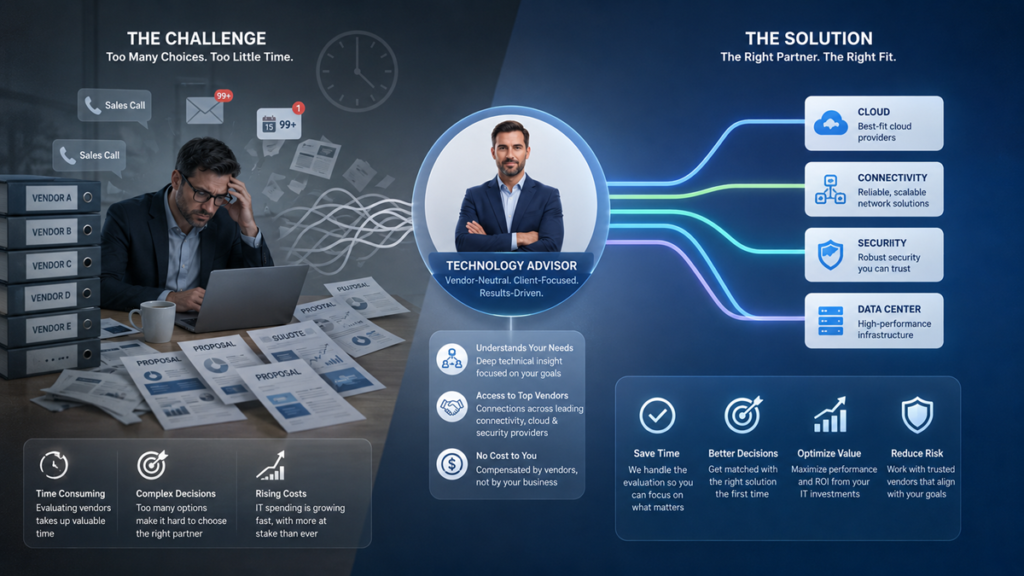
A technology advisor, sometimes called a technology services distributor or master agent, is different from a traditional systems integrator or management consultancy. Rather than billing for hours of strategy work, these firms broker connections between businesses and vendors, usually at no direct cost to the client because they’re compensated by the supplier side. The advisor’s job is to stay vendor-neutral, understand a client’s actual technical requirements, and match them with the right connectivity, cloud, or security provider from a large network of options.
What to Look For When Choosing an IT Advisory Firm
Small and midsize businesses spent a combined $1.1 trillion on IT globally in 2025, and that figure is projected to grow 7.2% in 2026 as SMBs shift budgets from capital expenditure toward subscription-based services, according to medhaCloud’s SMB IT Spending report. More than half of small and midsize businesses, 51%, now use a managed service provider, rising to 62% among midsize firms, per CompTIA-sourced data cited by CloudSecureTech. That trend makes the advisor selection itself a real decision, not an afterthought.
A few criteria separate a genuinely useful advisory partner from a glorified sales channel:
- Vendor neutrality: the firm should have no financial incentive to push one provider over a better-fit alternative.
- Breadth of network: a wider supplier base means more options for niche or regional connectivity needs.
- No-fee structure to the client, since the advisor is paid by the vendor upon a signed contract.
- Post-sale support, including help with implementation issues and billing disputes after the contract is signed.
- Industry-specific experience in regulated sectors such as healthcare, finance, and education.
- A track record with businesses of your size, since an advisor built for enterprise accounts may not prioritize a smaller deal.
1. CommQuotes
CommQuotes operates as a vendor-agnostic technology advisory and procurement brokerage rather than a consulting firm in the Accenture or Deloitte mold. It works with a network of more than 450 vendors, which gives it the flexibility to match a client’s actual technical and budget requirements rather than defaulting to a shortlist of preferred partners. For companies trying to identify the best IT advisors for their situation, that breadth matters more than a single big-name relationship.
The firm’s coverage spans three broad categories: communications (UCaaS, VoIP, and contact center platforms), connectivity (cloud infrastructure, SD-WAN, backup and disaster recovery, and MPLS), and cybersecurity and managed IT services. There’s no fee to the client for using CommQuotes, since the firm is compensated by the vendor once a deal closes. It serves clients across healthcare, manufacturing, education, retail, finance, and the public sector, industries where a wrong vendor choice carries compliance risk on top of the usual cost and downtime concerns.
2. Telarus

Telarus is widely described as the largest privately held technology brokerage firm in the US, working with more than 400 suppliers across cloud, network, and security categories. The technology services distribution market Telarus competes in grew 14.5% to $16.6 billion in gross billings in 2024, with the top six players controlling 72.3% of that share, according to Omdia’s analysis published via Informa Tech.
Telarus built much of its reputation on cloud and contact center sourcing, and it maintains a large partner-facing tools platform for the independent advisors who sell through its network.
3. AVANT Communications
AVANT Communications built its name on research and decision-support tools for trusted advisors rather than direct sales. Its platform helps independent brokers compare cloud, network, and security vendors using data rather than guesswork, which is part of why AVANT is frequently cited among the top-tier TSDs.
The firm has a particular strength in cloud architecture design, an area where a poorly configured migration can quietly inflate costs for years.
4. Intelisys
Intelisys, now a ScanSource company, has operated in the technology services distribution space for more than 20 years and is often described as one of the longest-running names in the category. It built a channel partner network around voice, data, cloud, and collaboration services, and that longevity gives it deep supplier relationships that newer entrants haven’t had time to build. Its scale makes it a common choice for advisors who want a proven back-office and commission-tracking infrastructure.
5. Sandler Partners

Sandler Partners is consistently ranked among the top six technology services distributors by gross billings, alongside Telarus, Intelisys, and AVANT. Its supplier portfolio spans cloud, security, and connectivity providers, and it’s built a reputation for supporting independent technology advisors with training and deal-desk resources rather than just a supplier list. That operational support tends to matter more once a deal moves past the initial quote stage.
6. TBI, Inc.
TBI, Inc. is a longtime master agent in the technology sourcing space, with a supplier catalog weighted toward cloud, security, and mobility solutions for small and midmarket clients. It doesn’t have the same brand recognition as some of the larger TSDs, but its focus on the SMB and mid-market segment means its advisors tend to have hands-on experience with the budget constraints and simpler IT environments common at smaller organizations.
Why Businesses Are Turning to IT Advisors in 2026
Unplanned downtime costs small businesses an average of $8,600 per hour, and managed-service-based IT models now deliver uptime service-level agreements of 99.5% to 99.9%, a standard most in-house teams can’t consistently hit on their own, according to Datto’s data cited by CloudSecureTech. That gap alone explains why so many companies are outsourcing critical infrastructure decisions rather than handling procurement in-house. Among small and midsize businesses that outsource IT, 58% cite access to specialized skills as the primary driver, followed by cost reduction at 49%.
An advisor’s real value shows up during the comparison process itself. Businesses evaluating multiple vendors, whether for network monitoring, cloud hosting, or a specific software category, benefit from the same structured, criteria-based approach a good technology advisor uses, an approach reflected in comparison guides like Heroic Rankings’ rundown of the best competitor analysis tools for marketing and competitive intelligence software.
Security also factors heavily into vendor selection, especially for businesses in regulated industries. Getting the fundamentals right on locking down your network infrastructure often starts before a vendor contract is even signed, since a provider’s security posture is only as good as the client’s own baseline configuration.
How to Evaluate Uptime, Security, and Support Before You Sign
Before signing with any advisor-recommended vendor, ask a few direct questions. What’s the actual uptime SLA, and what happens financially if it’s missed? Who handles support escalation when something breaks at 2 a.m.? Does the vendor provide its own monitoring, or will you need to run parallel checks?
That last question matters more than it sounds. Businesses serious about keeping server uptime high generally run their own monitoring alongside whatever the vendor provides, rather than relying solely on the provider’s dashboards. The same logic applies to network access: choosing the right VPN protocol for your business is a decision that shouldn’t be outsourced entirely to a vendor’s default recommendation, since protocol choice affects both security and connection performance for remote staff.
Vendor vetting doesn’t stop at technical specs. The Cybersecurity and Infrastructure Security Agency publishes a resource guide for developing a resilient supply chain risk management plan, aimed specifically at small and midsize businesses evaluating technology suppliers. It’s a useful checklist to run through before finalizing any vendor contract, regardless of which advisory firm helped source the options.
Conclusion
In a $6.31 trillion global IT spending environment, going straight to vendors without an intermediary means doing all the comparison work yourself, usually without access to the same volume-based pricing an established advisor can negotiate. Working with a vendor-neutral firm such as CommQuotes lets businesses compare options across a much wider supplier base while keeping the process free on the client side.
The six firms covered here approach the market differently, from CommQuotes’ broad vendor-agnostic model to the more established master-agent networks like Telarus and Intelisys. Whichever firm a business ultimately works with, the same three criteria matter most: vendor neutrality, breadth of supplier network, and support that doesn’t disappear once the contract is signed.
