


Every agency wants more revenue. Most of the advice out there will tell you to go chase new clients, but there’s usually easier money hiding in the accounts you’ve already won. Upselling has a terrible reputation. That’s mostly deserved, because nobody wants their account manager to flip into sales mode during a routine call.
Whether a suggestion lands well or gets ignored will come down to one question: did you spot a real problem and bring it up at the right time? Let’s discover how to build a repeatable process that catches those upsell moments so your team can act before the opportunity disappears.

Start With What You Already Know About the Account
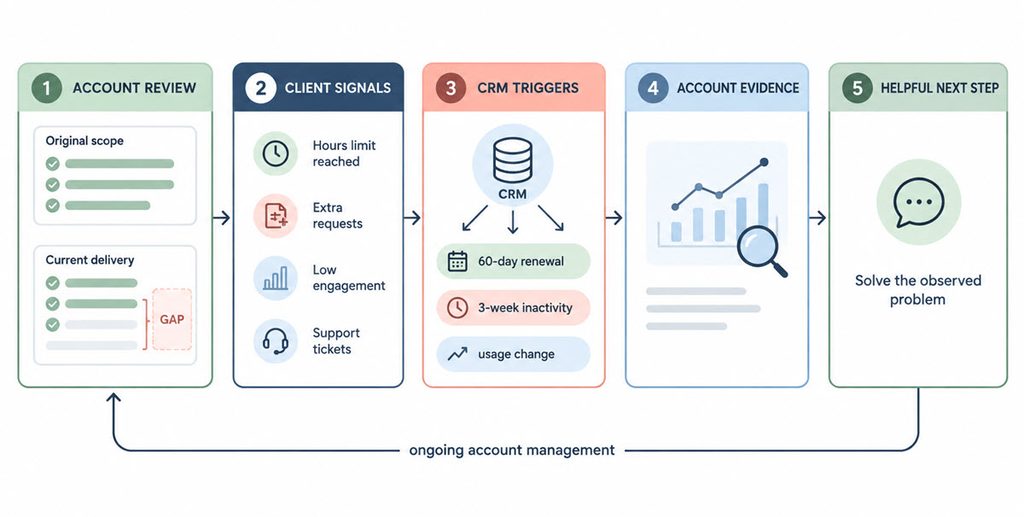
Before hunting for new signals, audit what you’ve already got. Pull up each active account and compare the original scope against what your team actually delivers today, because gaps between the two will give you your first leads. Client needs drift over time. A retainer signed eighteen months ago probably won’t reflect what the client actually requires now, and that mismatch between the old agreement and current reality is exactly where you’ll find your strongest opportunities.
Pay attention to how clients use what you currently provide. If someone consistently maxes out their monthly hours or keeps requesting one-off tasks outside the retainer, they’ve outgrown the original package and you’ll probably spot it in the data before they even bring it up themselves. You don’t need a slick pitch. Name the pattern you’ve noticed and ask whether it makes sense to restructure the arrangement so everything they actually need is properly covered.
Let Your CRM Do the Spotting for You
Manual account reviews work fine with a small client list, but they’ll break down once you’re managing more than a dozen accounts at once. Your tech stack can handle this. A properly configured CRM for agencies will flag renewal dates and contract milestones automatically, and it’ll catch drops in engagement too, so your account managers won’t need to rely on memory or scattered calendar reminders to keep track of everything.
Configure triggers for the moments that actually count: a contract renewal coming up in 60 days, a client who hasn’t logged into a shared platform in three weeks, a sudden jump in support tickets, or a usage drop that could signal growing frustration. The automation handles detection. Your account managers still need to have the actual conversation, but they’ll get the signal early enough to prepare properly and act before the window closes.
Frame It as Problem-Solving, Not Selling
How you frame the upsell matters just as much as when you bring it up. Account managers who lead with “we also offer X” will almost always get a polite brush-off, and the conversation dies right there. Compare sending over a generic rate card for content services with saying “we’ve noticed your organic traffic has plateaued over the last two months and we think there’s a content gap we could fill.” One is a pitch. The other shows you’ve been paying attention, and that difference will determine whether the client actually engages or just nods along until the call ends.
Evidence makes all the difference here. Your team should back every recommendation with data pulled straight from the client’s account, not a generic pitch deck that could apply to anyone. When a suggestion clearly ties to a problem the client already recognises, and the numbers support it, that conversation won’t land as a sales pitch because it genuinely isn’t one.
Why the Best Upsells Don’t Feel Like Upsells at All
If you look at agencies that consistently grow revenue from their existing clients, they’ll almost all share one trait: they treat expansion as a natural part of account management instead of a separate task tacked on at the side. Their teams will pay genuine attention to how each client’s business changes week to week, and their systems will flag those changes early. That combination is all it takes.
Upsell conversations will happen naturally during work that’s already underway, with no need for dedicated “upsell calls” or rehearsed scripts from a training folder nobody opens. If there’s one habit to take from all of this, make it reviewing your account data on a regular schedule and actually acting on what you find, because the agencies that do this consistently will be the ones growing without endlessly chasing new business.
