


The red USB port meaning depends on who made your board. A red USB port on a motherboard is usually either a faster port (10 Gbps, called USB 3.2 Gen 2) or an “always-on” port that keeps powering your phone or drive when the PC is off. Some boards do both, and some use red just for looks.
Colour coding is a convention, not a rule every manufacturer follows. So in this guide, I’ll show what red usually means, how to confirm it on your own machine, and what to change if the port does not behave the way you expect.
Quick answer: Red on a USB port normally means one of two things. Either it is a 10 Gbps port (USB 3.2 Gen 2, about twice the speed of a blue 5 Gbps port), or it is an always-on port that supplies power when the PC is shut down or asleep. Check the board manual or spec sheet to know which one you have.

Red USB Port Meaning: What Does It Signify?
It signifies a port the manufacturer wants you to notice. On most boards, going by vendor and reviewer descriptions, that comes down to the two meanings above:
1) Speed. Several brands use red for 10 Gbps ports (USB 3.2 Gen 2, earlier named USB 3.1 Gen 2). Corsair describes red ports the same way, with speeds from 10 to 20 Gbps. 2) Always-on power. Red (and yellow) ports are often the ones that stay powered in sleep and shutdown, so you can charge a phone or run a USB light without the PC being on.
About the 20 Gbps figure you may have seen: USB 3.2 Gen 2×2 is the 20 Gbps mode, and it only works through a USB Type-C connector. A rectangular Type-A port on the back of your board cannot be 20 Gbps, so a red Type-A port tops out at 10 Gbps.
If you are not sure which board you have, my guide on how to check what motherboard you have shows the 3 simple steps.
USB Port Colour Code: What Each Colour Usually Means
Here is the common pattern. Read “usually” literally, because makers can colour a port anything they like.
| Colour | What it usually means |
|---|---|
| Blue | USB 3.0 / USB 3.2 Gen 1, 5 Gbps. The most widely followed colour. |
| Red | 10 Gbps (USB 3.2 Gen 2), always-on power, or both. Varies by brand. |
| Yellow | Often an always-on port for charging, speed varies |
| Black | No promise at all. Can be USB 2.0 or a faster port on the same board. |
The spec sheet of your board is the only reliable guide. For the naming side (Gen 1, Gen 2, Gen 2×2), the Tom’s Hardware explainer on USB 3.2 naming is a good read.
Red USB Port vs Blue: Is a Red USB Port Faster Than Blue?
Often yes, but not always. A blue port is normally 5 Gbps. A red port is normally 10 Gbps on boards that use red for speed. So with an external SSD that can go beyond 5 Gbps, the red port will usually give you faster copies.
For a keyboard or mouse you will not see any difference, so use whichever port is closest. Keep the fast ports for external SSDs and big backups. If you are planning a full backup to an external hard drive, it is worth plugging it into the faster port.
Is a Red USB Port Always On?
Many are, but it is not guaranteed. Always-on means the port keeps its 5V standby power when the PC is off or in sleep, which is why a phone can keep charging from it. It is the same idea I covered in charging a laptop with USB, only on the desktop side.
The test is simple: shut down the PC, plug in a phone, and see if it charges.
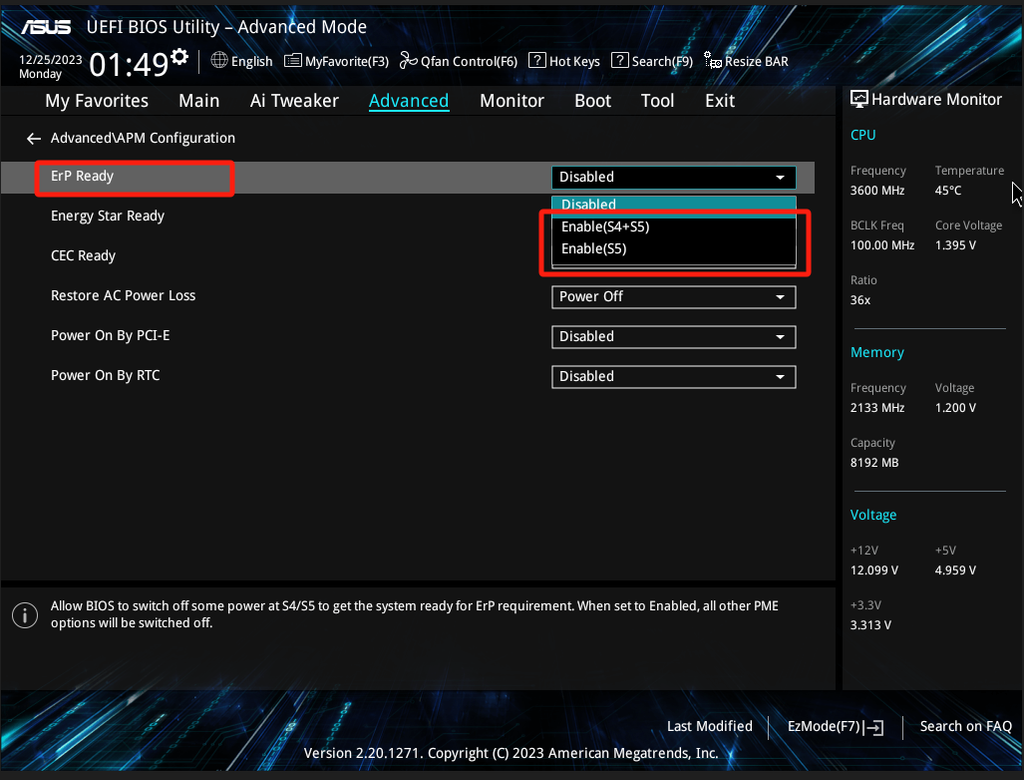
If it does not charge, or if it charges when you do not want it to, the BIOS decides:
- ASUS: In the BIOS Advanced Mode, open APM Configuration and look at ErP Ready. ASUS says to set it to Enable (S4+S5) or Enable (S5) to cut the USB standby power, as per the ASUS support FAQ. Windows fast startup also needs to be turned off, as per the same FAQ.
- MSI: MSI’s sleep and hibernate support page says to disable ErP Ready under Power Management Setup, and enable Resume By USB Device in the wake up settings, to keep USB charging after power off.
- Other brands: Option names differ by board model and BIOS version. Check the manual for your exact model.
One trade-off: enabling ErP can also stop Wake on LAN. If you remote in to wake your PC, keep ErP disabled.
How to Check the Speed of Your USB Ports
Do not trust the colour. Check the port itself:
- Open the motherboard manual or the spec page of the vendor, and look at the rear I/O list. It lists each port as USB 3.2 Gen 1, Gen 2 or Gen 2×2 with the speed.
- On Windows, a free tool such as USB Device Tree Viewer (UsbTreeView) shows the speed a connected device is running at. Newer versions show 10 or 20 Gbit/s as SuperSpeedPlus, but this needs Windows 11 24H2 or later.
- Copy a large file to a fast external SSD and watch the speed. If a 10 Gbps port gives you the same speed as a 5 Gbps port, the device itself is the limit.

USB Port Type vs USB Port Colour
People often mix up two different things here. The colour hints at speed or power. The shape of the connector is a separate matter:
- Type-A: The flat rectangular port on the back of almost every PC.
- Type-B, Mini and Micro: Older connectors used on printers, cameras and older phones.
- Type-C: The small reversible oval one. It can carry USB 3.2 Gen 2×2 (20 Gbps), but only if both the port and the cable support it.
A red Type-A port and a red Type-C port can behave quite differently, so check the manual.

If you are also wiring the case, the front panel connector details with labels page shows where the front USB headers go. Some people also ask about the MSI Super Charger, which is a different feature that boosts charging power on MSI boards.
FAQ
What is a red USB port?
A red USB port is a port the maker has marked as special. It is usually a 10 Gbps (USB 3.2 Gen 2) port, an always-on charging port, or both. It has no fixed meaning across brands, so the manual has the final word.
Can I use any USB device in a red port?
Yes. Red ports are backward compatible, so a USB 2.0 or 3.0 device works in them, just at the device’s own speed.
What does a red USB port on a motherboard do when the PC is off?
If it is an always-on port, it keeps supplying power, so a phone can charge. If not, it goes dead when the PC shuts down. An ErP or similar power setting in the BIOS can change this.
