


AI models are smart, but it’s certain that a vague question will always get a vague answer from the tool. If you ask something open-ended like ‘why is my system slow,’ expect a long list of generic answers, which will leave you confused like anything.
The output from the AI tool will look universal. IT troubleshooting works on a simple model: the more precise the prompt, the closer the first response is to an actual fix.
Start with a clear prompt
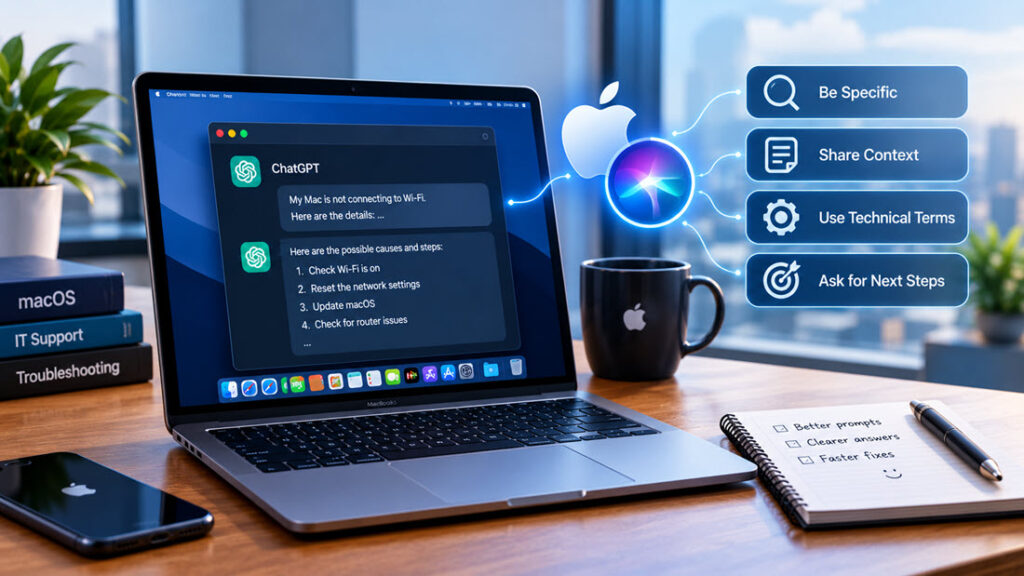
The common mistake users make is describing a symptom instead of a system. ‘Apps keep crashing’ tells an AI almost nothing specific. When you tell the exact name of the app, responses from AI assistants are more to-the-point. That’s when the guesswork turns into a helpful diagnosis output.
This is the foundation of prompt engineering best practices for any technical task, not just Mac troubleshooting specifically – the model can only work with what it’s actually been given and general problems just get general answers back. Going through a solid prompt engineering for Mac guide before troubleshooting anything complex is worth the time it takes. When you grasp these prompt patterns, then no matter which AI tool you use, the result will always be the best. Almost all AI models work with the same training, so the patterns you use produce the same results across models. Whether the prompt is about a hard disk crashing or cloud backup not syncing, the result on all AI models will be almost identical.
Request step-by-step diagnostics
Don’t simply ask ‘how do I fix this?’ That’s something amateurs are doing all the time and then they see themselves struggling for the right answers. You as a pro should instead ask the AI to walk through the diagnosis as a sequence – check this first and what each possible result could mean. A single flat answer risks skipping past the actual cause.
- Examine the website system prompt steps one at a time.
- Restart the affected app.
- Check the console for a crash log and test in a new user account.
- Whenever applicable, share things like macOS version, chip type, exact error message, etc. help in getting the right output from the AI model.
The sequence means there’s a chance of getting close to the actual problem without unnecessary experiments.
Prioritize the right fix
There’s no single possible cause for a Mac issue. Ask AI to list a few likely causes ranked by probability. A structured ranking is one of the more useful advanced prompt engineering techniques – checking for a pending macOS update first, since that alone resolves a surprising share of app-crash reports, is a common example of where that ranking should start.
Ask for safe terminal commands
Here’s a recipe for disaster. AI gives a command based on your query. And you, without verifying it, simply copy it into the terminal. Maybe you are not aware of the nuances or maybe you did not care about it at all before copying it directly. Whatever the case maybe, you are basically taking a risk where system files could be modified or sensitive data could be deleted without any warning.
Once a command is there in an AI tool, ask it more about the details, like what the command actually does. Go in details and proceed to the terminal only after you are sure of how it will work out. This is one of the basics that prompt engineering for developers teaches.
Verify AI-generated fixes
AI tools have progressed very fast in a short span of time. In just around half a decade, AI has become mainstream in almost every IT process. But as it’s commonly known, there are still some glaring gaps. What you see as a confident answer could be entirely wrong. AI-generated fixes, therefore, need to be analyzed deeply, especially if you are handling something sensitive like system settings or file deletion. It’s better to check Apple’s official documentation or any such resource that could help in cross-checking.
Save prompts for reuse
When a prompt produces a result that actually solves the IT problem, save it for future reference. This will help you build a small library of useful prompts that you can go back to whenever a similar problem arises in the future. It’s like a prompt engineering tutorial developed by you for yourself and the entire IT team.
Conclusion
A properly structured prompt gets an AI assistant a lot closer to a real answer than a one-line description of a problem ever will. How quickly you fix an IT issue and with how much minimum effort is all about producing that perfect prompt that the AI model can comprehend in the best manner.
