


Organisations in the modern world are extremely dependent on digital systems to store information, to run businesses, as well as to communicate with customers. Technology infrastructure is a major concern, but human conduct tends to play a significant role in keeping a company safe or making it a target of cyber attacks. Most companies are interested in installing security software and keeping networks up-to-date, but they ignore the importance of staff awareness.

Cybercriminals often do not attack systems; instead, they attack people since errors made by humans are more readily exploited. Cybersecurity training can also be incorporated into a general technology strategy to enable businesses to have the ability to increase their defenses. This is why training of employees on cybersecurity must be regarded as a vital part of any IT plan managed.
Employee Awareness and Threat Prevention
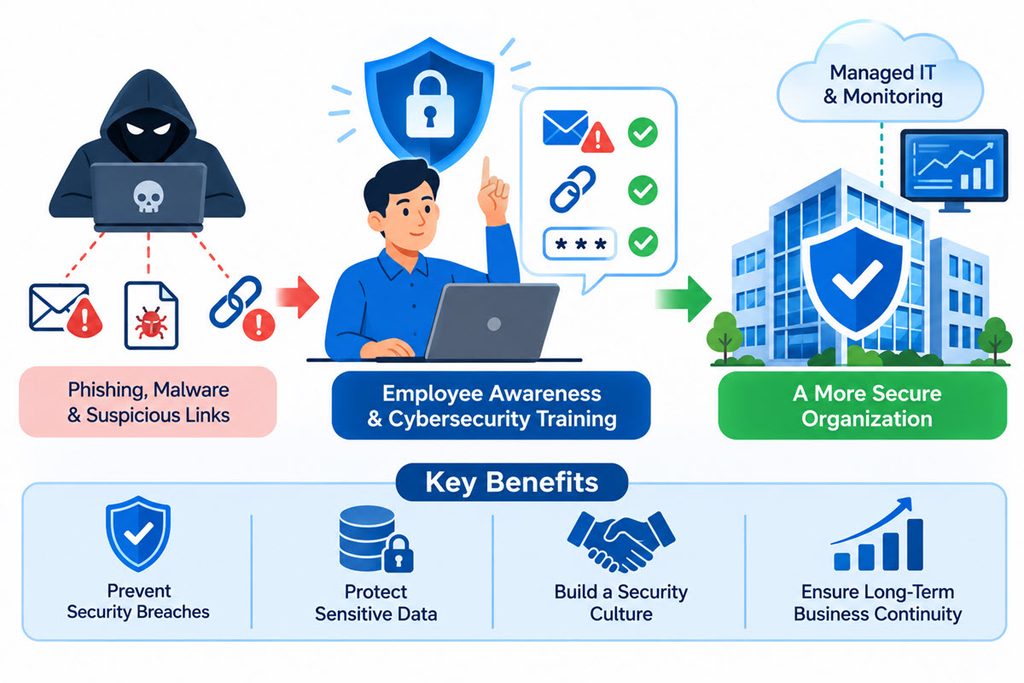
Workers are usually the first line of defense between an organization and any form of cyber threat. Phishing messages, malicious attachments, and spoof links often get into the hands of employees before they are met by automated processes. An employee can do this without being aware of what he is getting himself into and may end up giving out sensitive information that may jeopardise company data.
Cybersecurity training assists employees to be aware of red flags that are present like suspicious email addresses, uncharacteristic file attachment, and urgent emails asking to provide confidential information. When employees understand the warning signals, then they can help safeguard the business from cybersecurity threats. Consciousness turns employees who could be the weak links into well informed warriors who are able to detect threats before they run out of control.
Besides detecting phishing campaigns, training also changes the manner in which employees conduct their daily online activities. Employees should be educated about secure passwords, safe browsing, and effective data storage methods. Such practices will go a long way in minimizing the risks of accidental security breaches through human error.
If cybersecurity knowledge is introduced in the work culture, employees will start to treat digital work more attentively. Rather than thinking that the IT department has the sole duty of keeping the systems safe, staff members will understand that they have a part to play in ensuring that the systems are safe. This change of attitude enhances the general security of the organization.
Integration With Managed IT Strategies
Managed IT services Toronto are aimed to offer companies a stable technical support system, monitoring of the system, and maintenance of the infrastructure. However, technology alone will not be enough to remove cybersecurity threats. Sophisticated security measures might still be circumvented in case staff members inadvertently provide access to the intruders by phishing or unprotected actions.
With cybersecurity training as a part of an overseen IT strategy, enterprises develop a more comprehensive security system. Technical security measures like firewalls and monitoring systems are used to support the employee awareness programs to deal with the technological and human vulnerabilities. It is a middle ground that allows organizations to react better to the current cyber threats.
Training programs can be also organized together with monitored IT solutions that keep track of the network activity and can detect any unusual behavior. Training the employees to report suspicious cases is one of the ways through which IT professionals can respond to cyber threats at an earlier stage. Timely reporting will decrease the duration that attackers can employ systems and enhance the likelihood of avoiding the losses of data.
IT providers can help companies to create the timeline of training, provide learning resources, and introduce the staff to the latest trends on cybersecurity. Cyber threats are always evolving so continuous training is required for staff members to be aware of new risks. Technology management and human education should be combined to enable companies to establish more robust defenses in response to the digital threat.
Long Term Security and Business Protection
Cyber attacks have the potential to cause monetary loss, brand damage, and temporary business delays. Further, if the data breach is due to severe business neglect, they can be fined by court or regulators. Businesses that invest in employee training are in a better position of avoiding any incidents that would destroy their long term stability.
The other long term benefit of cybersecurity training is the development of a security oriented work culture. Cybersecurity becomes a normal activity of the business when employees are continuously provided with instructions on digital safety. Employees feel freer to inquire, report suspicious activity and use best practices.
In the long run, such awareness culture minimizes chances of high security incidents. The staff is more vigilant on possible threats and works in closer collaboration with IT departments. Consequently, organizations that place value on cybersecurity education are in a better position to handle emerging digital threats and dynamism in the technology environment.
