


Customer portals face a growing threat from accounts built with a mixture of fabricated details and genuine personal data. Synthetic identity fraud can pass basic checks because each data point may appear plausible when reviewed separately. Once accepted, these accounts can remain quiet for weeks or months while building credibility, changing profile information, and gaining access to higher-value services. Effective protection requires stronger onboarding controls and continuous checks throughout the account lifecycle.

How Fake Identities Infiltrate Systems
A synthetic identity often combines a real address or identification number with a false name, altered birth date or computer-generated profile image. Criminal groups may submit several variations, then observe which combinations pass automated checks. Successful identities can be reused across multiple portals.
The warning signs are usually subtle. Several applicants may share the same device, mailing address, or recovery contact while presenting different names. An account might also receive profile changes shortly after approval. Track these connections through device intelligence, network data and behavioral analysis. A risk score that considers relationships between accounts can expose coordinated activity that a single-record review would miss. Monitoring early identity-related threats and signs of targeted social engineering can also help security teams identify suspicious activity before it leads to unauthorized access.
Vulnerabilities in Standard Account Creation
Many registration systems validate whether fields are complete but don’t establish whether the applicant controls a legitimate identity. Email confirmation proves access to an inbox, while text verification only shows control of a phone number. Neither test confirms that the submitted identity details belong together.
Review every account creation step for controls that attackers can automate or repeat. Rate limits should apply across devices, network addresses, and shared identity attributes. For higher-risk portals, a document verification API can authenticate submitted identity documents and support automated identity proofing during onboarding. Route unclear cases to trained reviewers instead of automatically approving or permanently rejecting them based on one signal.
Integrating Real-Time Verification Tools
Run verification while the user is active so the system can respond to the risk presented by that specific session. A low-risk returning customer may need only a normal login, while a new account created through an anonymized connection may require extra evidence.
Set clear thresholds for approval, rejection, and manual review. Your workflow might approve applications with consistent document, device and contact data, then send mismatched records to a review queue. Follow established identity proofing guidelines when deciding how much evidence a service requires. Record the result, reason code and tool version for each decision so support and compliance teams can reconstruct what happened.
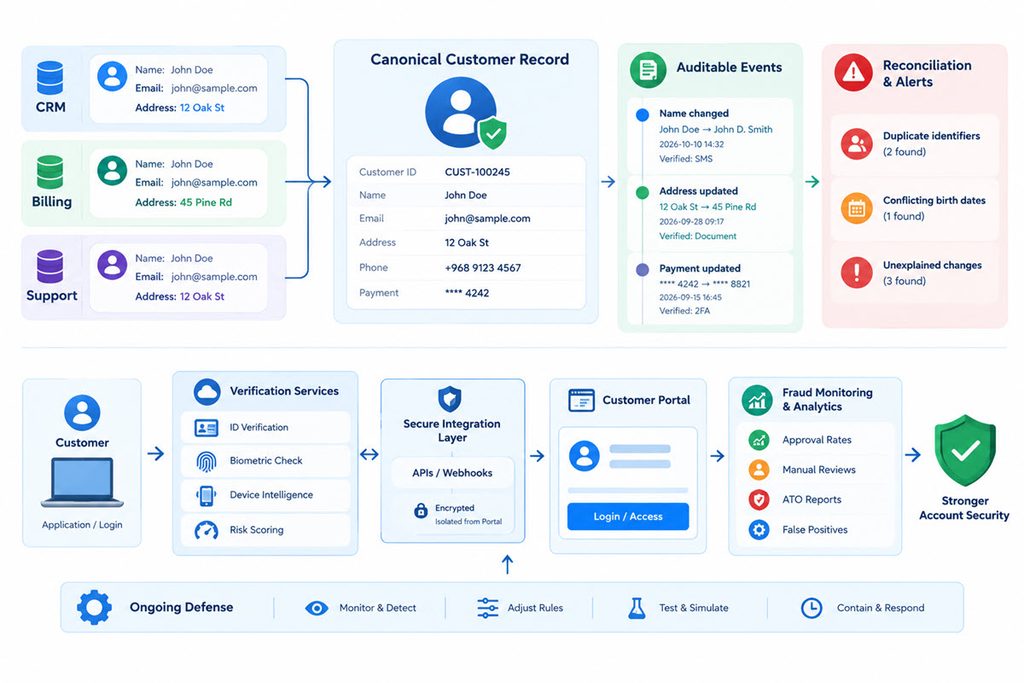
Securing Data Integrity Across User Records
Identity controls weaken when records drift apart across customer relationship software, billing systems and support platforms. A user may change an address in one system while older details remain trusted elsewhere. Attackers can exploit those gaps by presenting whichever version supports their request.
Create a canonical customer identifier and define which system owns each field. Sensitive changes, including names, recovery contacts, and payment details, should generate an auditable event with the previous value, new value, timestamp, and verification method. Restrict direct database edits and require service accounts to use authenticated interfaces. Regular reconciliation jobs can then flag duplicate identifiers, conflicting birth dates or unexplained changes before those errors affect access decisions.
Long-Term Defensive Architecture Strategies
Treat fraud controls as a maintained security system, not a one-time onboarding project. Fraud patterns change as attackers learn which checks trigger reviews. Monitor approval rates, manual review outcomes, account takeover reports, and false positives by channel. A sudden rise in applications from one device family or network range may justify a temporary rule while analysts investigate.
Keep verification services separate from the main portal through well-defined interfaces. This design lets you replace a provider or update scoring logic without rebuilding account creation. Protect stored evidence with encryption, strict retention limits, and role-based access. Finally, test the full workflow with simulated applications, including borderline cases that should reach human review. The most useful defensive metric is how quickly your team can detect and contain a suspicious identity cluster before it spreads across connected records.
