


Most of us never think about how data finds its way across the internet. You open a site, it loads, and the machinery that decided which path your traffic took stays invisible. That machinery is called Border Gateway Protocol, or BGP, and when it misbehaves the effects are anything but invisible. Whole services can vanish from the internet for hours. This article explains, in plain terms, what BGP monitoring is, why it matters, and how the tools for it have changed.
The short version of how internet routing works
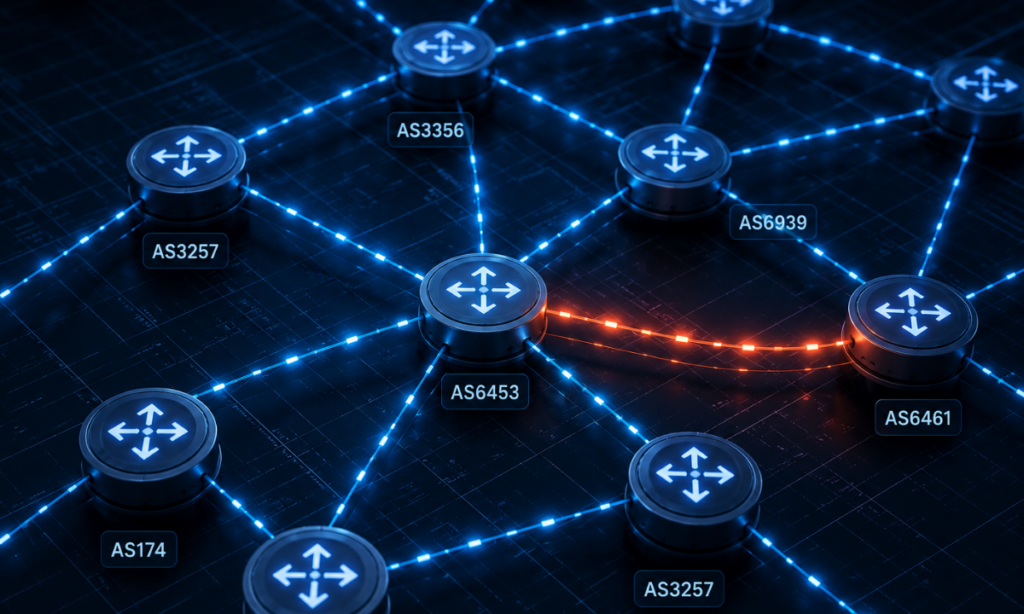
The internet is not one network. It is tens of thousands of separate networks, run by internet providers, cloud companies, universities and businesses, all connected together. Each of these networks is called an autonomous system, and BGP is the language they use to tell each other how to reach different parts of the internet.
When one network announces “traffic for this range of addresses should come to me,” its neighbors pass that message along, and within a short time, the new routing information propagates across the Internet. It is an elegant system, and it has one glaring weakness. For most of its history, networks simply trusted these announcements. There was no built-in way to check whether a network was actually allowed to claim a given range of addresses.
Why that Trust is a Problem
That trust has been abused, sometimes by accident and sometimes on purpose, with real consequences.
The classic example happened in 2008, when a single provider announced that it was the correct destination for a slice of YouTube’s addresses. The false announcement spread worldwide, and YouTube went dark for about two hours as traffic meant for the site was pulled toward the wrong network. Nobody had to break in anywhere. They just made a claim, and the internet believed it.
Years later, attackers used the same kind of routing trick for theft, redirecting traffic for a cryptocurrency service to a fake site and draining money from people who thought they were in the right place. These events are known as route hijacks, and their quieter cousins, route leaks, cause outages without anyone intending harm at all. In every case, the damage is worse when the affected network finds out late.
What BGP Monitoring Actually Means
BGP monitoring is simply the practice of watching these routing announcements to catch problems early. Done well, it answers a handful of questions as routing changes occur. Who is currently announcing a particular range of addresses? Are they allowed to? Has anything about this changed recently, or does it look like an attack or a mistake?
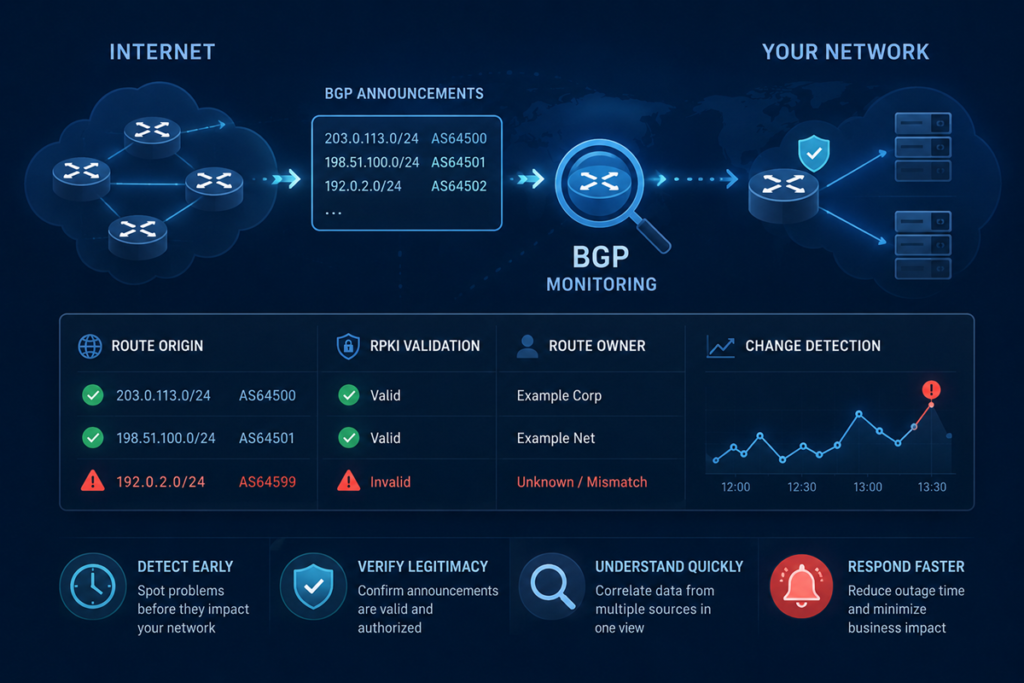
Answering those questions has traditionally been awkward. The information is spread across several separate tools. One service tells you who is announcing a route. Another checks whether the announcement is cryptographically authorized. A third tells you who really owns the addresses. During a problem, someone has to gather all of this by hand and piece it together, which takes time that a live outage does not give you.
There has been real progress on the security side. A system called RPKI now lets the rightful owner of an address range cryptographically sign a statement of who is allowed to announce it, and adoption has grown enough that many large networks now reject announcements that fail the check. That closes off many of the simplest hijacks. But rejecting bad routes at your border is only half of it. You still need to see problems as they happen and understand them quickly.
How the tools have changed
This is where routing monitoring has taken a step forward. Rather than juggling separate services, network teams can now use a single system that brings all of this information together.
FastNetMon recently launched a self-hosted platform for routing intelligence built exactly for this. It watches routing announcements live, straight from the routers, and combines them with the ownership records, the cryptographic validation, and the history of how a given route has behaved before. Instead of five tools and a lot of manual cross-checking, an engineer sees one screen that already says who is announcing a route, whether they are allowed to, and whether this is normal.
The word self-hosted matters here. The platform runs inside the network operator’s own systems rather than as an outside service, which means the data never leaves their control and there are no external limits on how often they can check. FastNetMon founder Pavel Odintsov explained the thinking behind it: “Internet routing has become critical operational infrastructure, yet many organisations still depend on multiple external services to understand what is happening in their own networks. We built Netomics to give operators complete ownership of their routing intelligence while making it easier to troubleshoot incidents, automate workflows and improve routing security.” The company laid out the full details in FastNetMon’s blog post announcing it.
Who actually uses this
You will not find BGP monitoring on a home PC, and it is not something an ordinary user sets up. It lives with the organisations that run large chunks of the internet. Internet providers use it to keep their customers connected. Cloud companies use it to make sure traffic reaches the right data centre. Internet exchange points, the physical hubs where many networks meet, use it to keep those connections honest. Large businesses that run their own address space use it to protect their online presence.
For all of them, routing is not a background detail. It is the thing that determines whether their services are reachable at all. When it breaks, everything downstream breaks with it, which is why these teams increasingly want live, trustworthy visibility into it rather than a periodic guess.
Why this matters even if you never touch a router
You might never configure a network, but you rely on this stuff constantly. Every service you use depends on routing that works and stays honest. When it fails, sites go down, transactions get redirected, and the outages make the news. Better routing monitoring is part of why those incidents are getting easier to catch and shorter when they happen.
So the next time a major site blinks out for an hour and the explanation mentions a routing problem, you will know what actually went wrong underneath. Some network made a claim, the internet believed it, and the people affected were racing to see it and undo it. The whole point of modern BGP monitoring is to make that race a lot shorter.
